
The basic role & task of R&D Sp Wg of DGRDE is to help in
- 2D Drawings
- 3D Modeling
- 3D Scanning
- 3D Printing
2D Drawings
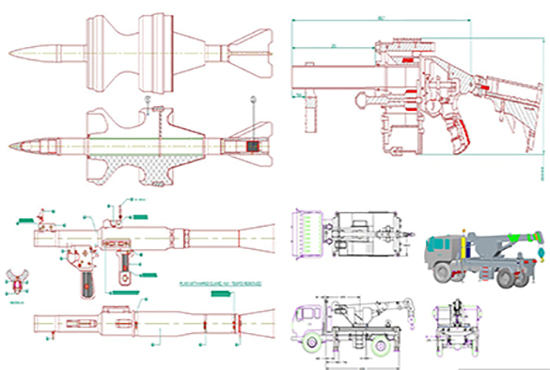
We create technical drawings with an array of features, including adjustable line styles, closed shapes, and crosshatching. 2D CAD offers the ability to save settings, annotate drawings, and easily replicate fonts, styles and color pallets. Its collaborative interface increases efficiency with multiple-component projects, such as product design or illustrations. Our 2D Designers convert the vision into 2D Drawings.
3D Modeling
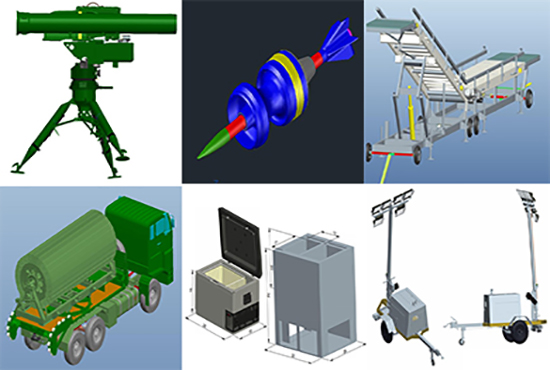
3D modeling is a technique in computer graphics for producing a 3D digital representation of any object or surface. A designer uses special software to manipulate points in virtual space (called vertices) to form a mesh: a collection of vertices that form an object. Modeling three-dimensional solid features often begins with creating two-dimensional sketch defines a portion of the shape of your part. Sketching involves the creation of lines, arcs, circles and dimensions.
3D Scanning
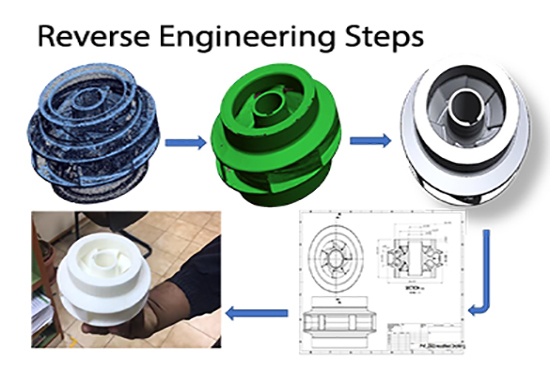
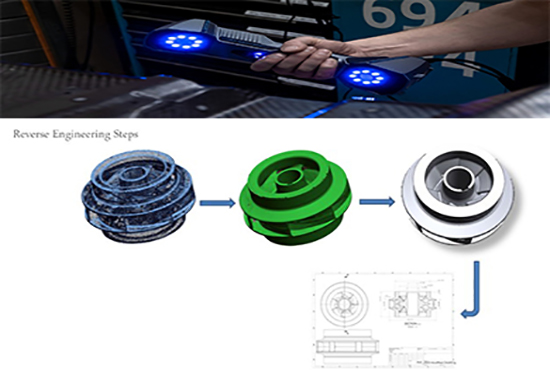
3D scanning is the process of analyzing a real-world object or environment to collect data on its shape and possibly its appearance. Reverse engineering is a process in which machines, aircraft, architectural structures and other products are deconstructed to extract design information from them. Often, reverse engineering involves deconstructing individual components of larger products. The reverse-engineering process involves measuring an object and then reconstructing it as a 3D model. The physical object can be measured using 3D scanning technologies. The measured data represented as a point cloud, lacks topological information and is therefore often processed and modeled into a more usable format such as a triangular-faced mesh, or a CAD model.
3D Printing
3D printing, also known as additive manufacturing is a process in which a digital file is used to create a 3D dimension solid object.
Process to Scan an Object for 3D Printing: The Reverse Engineering Workflow